EV Basics
Electric cars come with a few words and numbers that show up everywhere — on the dash, in ads, and in arguments online. This guide explains the basics in everyday language so the rest of the site (and the charging calculator) makes more sense.
You do not need to memorize formulas. Think of this as a pocket glossary you can return to.
kWh, miles per kWh, and usable battery
kWh (kilowatt-hour) is a chunk of energy — like a “gallon,” but for electricity. Your car’s battery is measured in kWh. A bigger number usually means more energy on board (and often more range), but how far you go also depends on how efficiently you drive.
Usable battery is the portion of the pack the car actually lets you use day to day. Marketing sometimes quotes a larger “total” size; the usable number is what matters for charging math and range estimates.
The car usually holds back some capacity on purpose — not to be wasteful, but to keep the battery healthy over years of driving. Our charging calculator asks for usable kWh.
mi/kWh (miles per kilowatt-hour) is efficiency — how many miles you get from each kWh. Higher is better for range and for overnight charging. Rough ballpark for many everyday EVs:
- Around 2.5 mi/kWh — less efficient driving, cold weather, or a larger vehicle
- Around 3–3.5 mi/kWh — common mixed driving
- Around 4+ mi/kWh — efficient car and gentle driving
Your real number changes with speed, weather, hills, and cabin heat or A/C. That is normal.
All that talk about how battery range goes down in the winter? That’s actually true — they do. But it’s not as big a deal as you might think, and matters more for road trips than daily commutes.
Got a lead foot or like to drive really fast? Highway speed matters a lot. A useful rule of thumb: think of quoted highway range as closer to ~70 mph. If you drive 65 mph, you’ll often get a little more range; if you always drive 80 mph, you’ll get less. The difference grows the farther above or below that you get. (Sticker range itself comes from lab tests — not one fixed speed — but real-world highway miles still behave a lot like this.)
LFP and NMC batteries
You’ll see letters like LFP and NMC in reviews and spec sheets. They’re just two common types of EV battery chemistry — different recipes for the same job: store energy and send it to the motors.
You do not need a chemistry degree to buy or drive an EV. Here’s the friendly version:
NMC (a nickel-based mix) is common on many long-range models. Good energy in a given size — helpful when you want more miles without a huge pack. Some owners treat daily charging a bit more gently (for example, not leaving the car at 100% for weeks) because the manual suggests it. Follow whatever your car recommends.
LFP (lithium iron phosphate — people just say “LFP”) shows up a lot on value and standard-range trims. It’s known for being tough and often fine with more regular charges to 100%, which is nice for simple overnight habits. The tradeoff is sometimes a bit less range for the same pack size, or a DC fast charge that eases up sooner near the top — still totally workable for most drivers.
These are the batteries you’ll typically find powering homes and businesses too; they’re safe, reliable, and cheap, and retain most of their capacity over a decade or more.
Neither one is “the scary kind.” Both power millions of normal cars. Pick the vehicle that fits your budget, range needs, and charging situation; treat chemistry as a bonus detail, not a pop quiz.
Level 1 vs Level 2 vs DC fast
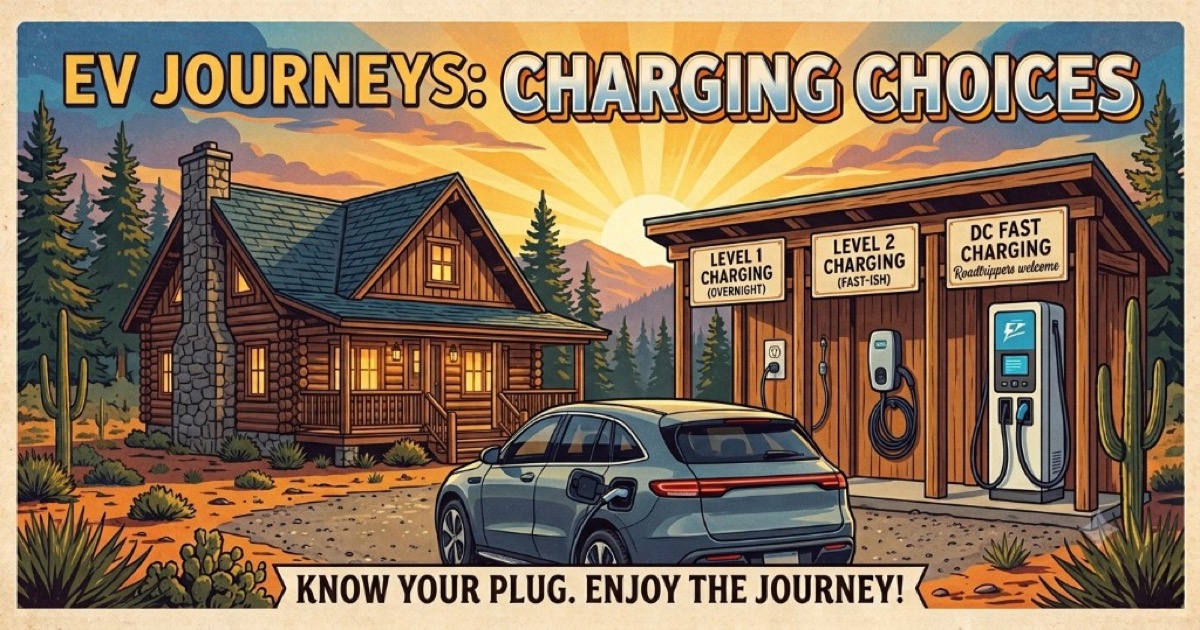
Charging is not one thing. Three common categories:
Level 1 — 120 V household outlet. Plug into a normal wall outlet with the cord that often comes with the car (or a portable EVSE — the brick/box that controls charging). Slow. Overnight on Level 1 may cover a 20–30 mile daily commute — or it may not. Try the numbers in the charging calculator rather than guessing.
Level 2 — 240 V. Home wall chargers and many public stations at places like the mall. Many hotels have destination chargers you can plug into for free or a small overnight fee. Much faster overnight recovery — you’ll usually have a full EV in the morning.
Common home installs cost $1,000–$2,500 if you need to hire an electrician to run a new circuit, but if you already have a 240 V outlet in your garage, you may be able to just buy a $300–$500 charger.
DC fast (highway / “fast charge”). High-power stations for road trips. Adds a lot of range in tens of minutes, then usually slows as the battery fills. Drivers often stop around 80% on a DC fast stop because the last stretch is slower — habits we cover more in road-trip guides later.
Home charging is usually Level 1 or Level 2. DC fast is the road-trip tool.
Plugs and connectors
Charging levels describe how fast. Connectors describe what shape the plug is — and the plug has to match the port on your car. In North America you will meet three.
J1772
J1772 is the AC connector. Round body, five pins, a small latch tab at the bottom. Nearly every non-Tesla EV sold in North America before the switch to NACS uses it for Level 1 and Level 2 charging. It handles AC only — there is no version of J1772 that does fast charging.
CCS1
CCS1, or “Combo 1,” is J1772 with two large DC pins added underneath. That is what “Combo” means: the top half is the same J1772 you use at home, and the bottom half only wakes up at a DC fast charger. Your car has a single inlet that accepts both, so a CCS1 car charges from a plain J1772 cable at home and a CCS1 cable on a road trip.
NACS
NACS (standardised as SAE J3400) is the Tesla-designed connector that most automakers have now adopted. It is noticeably smaller, and it carries both AC and DC through the same two large pins — which is why it needs no separate DC section the way CCS1 does.
Telling them apart at a glance: round with five pins is J1772. That same round shape with two big circles below it is CCS1. The small tapered shape is NACS.
Adapters exist between these, and direction matters — a NACS-to-J1772 adapter lets a NACS car use a J1772 station, which is not the same product as the adapter that goes the other way. Our charging equipment picks are grouped by connector for this reason.
Why you’ll see “CCS1” and “CCS2”
Worth knowing so online advice doesn’t confuse you: CCS comes in two versions that are not interchangeable. The one described above is CCS1, and it is what North America uses.
CCS2 is the European version. It is built on a different AC connector (Type 2, often called Mennekes) because Europe commonly has three-phase power, which J1772 does not carry. Both versions add the same pair of DC pins underneath, so the fast-charging half looks similar — it is the AC connector on top that differs.
The practical upshot: if a guide, video, or forum post about “CCS” looks like it was written in Europe, it means CCS2, and that plug does not fit a North American car. NACS is likewise a North American standard rather than a global one.
State of charge (SOC)
State of charge (SOC) is simply “how full is the battery?” — shown as a percent on the dash (and in many apps).
- 100% — full (fine for daily driving; some cars recommend not sitting at 100% for weeks)
- ~80% — a common place to stop on a DC fast charge, or a comfortable daily charge limit
- Low teens or single digits — time to plan a charge soon; leave buffer for weather and hills
SOC is not the same as “miles remaining.” Miles remaining is an estimate that assumes recent or average efficiency. Most experienced EV drivers set their car to percentage only, because estimated miles often just cause unnecessary range anxiety. Cold weather or fast highway driving can make the “miles left” number drop faster than the percent alone suggests.
Range vs efficiency
Range is how far you can go on a charge — the number ads love. It depends on battery size and efficiency, and on conditions.
Efficiency (mi/kWh) is how thrifty the car is with energy. Two cars with the same battery size can have different range if one uses energy more carefully.
A useful mental model:
Rough range ≈ usable kWh × mi/kWh
Example: 75 kWh usable × 3.5 mi/kWh ≈ about 260 miles in those conditions — not a promise, just the shape of the math. Speed, temperature, and hills move the real number.
That’s also why winter gets a bad reputation: efficiency drops (cabin heat, cold battery), so the same pack delivers fewer miles — not because the car refuses to drive.
Trip history your car can export
Some cars can export a file or stream of recent trips or current driving details — dates, distances, energy used, sometimes start and end places. Brands name and format these differently. You might see “journey log,” “trip history,” “driving data,” or something else in the owner’s app or in-car menu.
EV Journeys’ optional trip analyzer (available today for Polestar) is for people who already have that kind of export and want to explore it on their own device. You do not need an export — or the trip analyzer — to use the guides and calculators on this site.
If your car is not supported yet, you can still learn the basics here, and tell us what you drive if you want us to prioritize it.
What’s next
- Try the charging calculator with a vehicle preset or your own numbers.
- Browse more guides as we add home charging, costs, and road-trip topics.
- Read our Privacy Policy if you are curious how trip files are handled in the trip analyzer (short version: they stay on your device).